ISFT-Series-3: Derivatives & Fixed Income Markets Certificate
Your job-ready path into derivatives and fixed income: how professionals price, hedge and think about rates. 10 modules, 20 credits and 200 learning hours online, with a live session every week.
~20 weeks (200 learning hours)
No formal entry requirements. Series 1, or equivalent market knowledge, is recommended
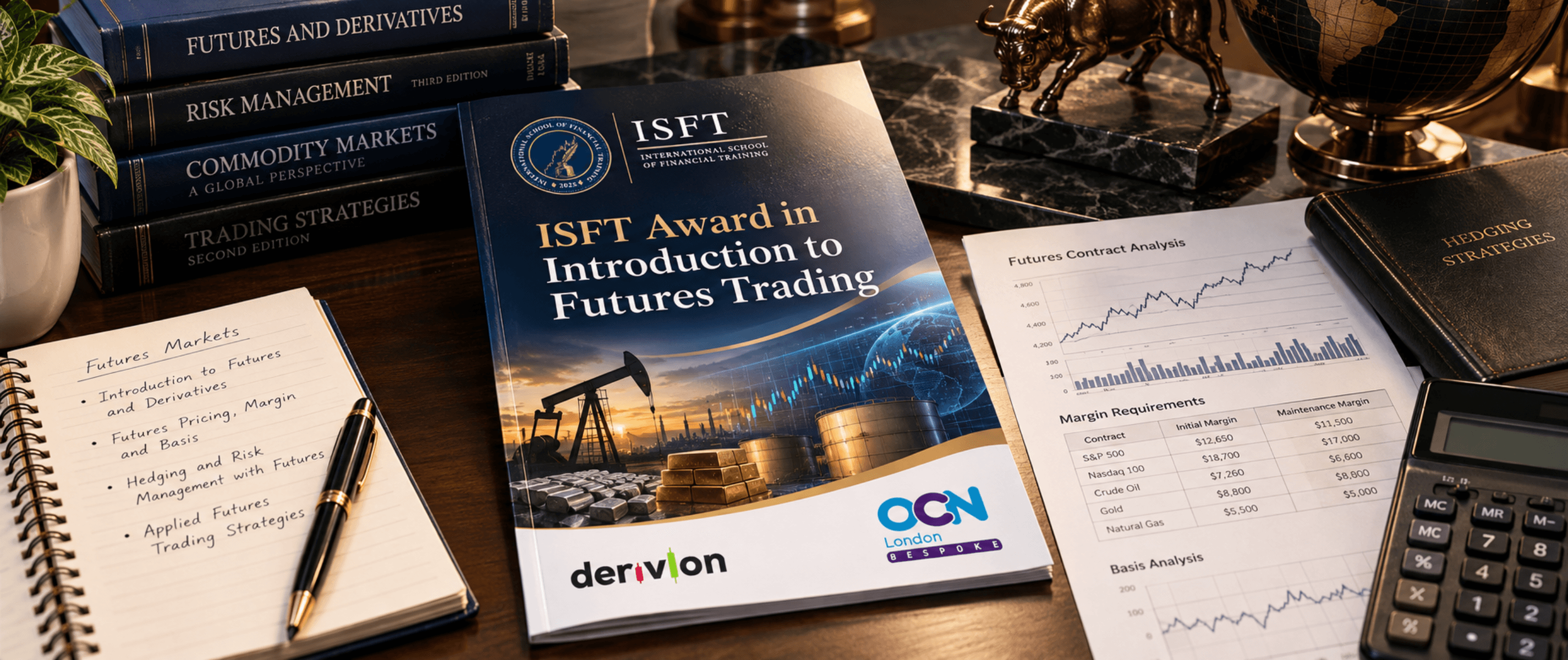
Programme snapshot: ISFT-Series-3: Derivatives & Fixed Income Markets Certificate
Why Choose This Programme?
One complete programme: you learn how futures are priced, margined and used to hedge risk, then how bonds work, how yields and prices move, how the Indian government securities market operates, and how bond futures and yield curve trades are built.
These are the skills treasury, fixed income and derivatives desks look for. Mechanics come first, contract specification, pricing and margin before strategy, so every later decision rests on solid ground.
Study at about 10 hours a week including the live session. Most learners finish in around 20 weeks, and a new batch starts on the 1st of every month.
Core Aim & Reflex
How professionals price, hedge and think about rates.
One complete certification: ten modules, two practical projects and a final case, certified through OCN London and ISFT.
Mechanics first: contract specification, pricing and margin before strategy, so every later decision rests on solid ground.
A dedicated Indian G-Sec module: the Reserve Bank of India's role, the RBI Retail Direct platform, and how a retail investor actually participates.
Applied, not just informational: you construct and justify a futures hedge, then analyse a bond market scenario in a written report.
Curriculum Architecture
Structured into progressive modules with hands-on scenario analysis, habit drills, and concrete reflection milestones.
Introduction to Futures and Derivatives
What a standardised futures contract is, how it differs from a forward or an option, and who makes the market work.
Topics & Episodes
- Explain the key features of a standardised futures contract
- Describe how futures contracts differ from forward contracts and options
- Explain the roles of a futures exchange and clearing house
- Describe the concept of contract standardisation and its benefits
Module quiz: 25 multiple-choice questions in 75 minutes, 70% pass mark, auto-marked online with retakes.
Futures Pricing, Margin and Basis
How a futures price relates to the spot price, why basis changes over time, and what keeps a leveraged position open.
Topics & Episodes
- Explain the relationship between spot price and futures price
- Define the concept of basis and explain why it changes over time
- Explain the difference between initial margin and maintenance margin
- Calculate a simple margin call scenario given basic price movement data
Module quiz: 25 multiple-choice questions in 75 minutes, 70% pass mark, auto-marked online with retakes.
Hedging and Risk Management with Futures
How a futures contract protects an existing exposure, and the risks, leverage above all, that come with trading one.
Topics & Episodes
- Explain the principle of hedging an existing exposure using a futures contract
- Identify an appropriate futures hedge for a given underlying exposure
- Explain the concept of leverage risk in futures trading
- Identify the main risk management tools available to a futures trader
Module quiz: 25 multiple-choice questions in 75 minutes, 70% pass mark, auto-marked online with retakes.
Applied Futures Trading Strategies
Common speculative strategies, then bringing pricing, margin and hedging knowledge together in a real trading decision.
Topics & Episodes
- Describe a trend-following strategy applied to a futures market
- Describe a spread trading strategy involving two related futures contracts
- Construct a hedge for a given underlying exposure and calculate the associated initial margin requirement
- Justify the trading and hedging decision using market reasoning, against sound risk management principles
Project 1: an 800–1,200 word applied futures scenario report. Construct a hedge for a given exposure, calculate its initial margin, and justify the decision using market reasoning and sound risk principles.
Understanding Bonds and How They Work
The basic features of a bond, how it generates a return, and why investors hold government bonds within a diversified portfolio.
Topics & Episodes
- Explain the key features of a bond: face value, coupon, maturity
- Describe how a bond generates returns for an investor
- Explain why investors hold government bonds as part of a diversified portfolio
- Compare the risk and return characteristics of bonds relative to equities
Module quiz: 25 multiple-choice questions in 75 minutes, 70% pass mark, auto-marked online with retakes.
Bond Risks, Market Structure and Price Drivers
The main risks of holding a bond, how duration relates to interest rate sensitivity, and what actually moves government bond prices.
Topics & Episodes
- Explain interest rate risk, credit risk, and inflation risk as they apply to bonds
- Identify how duration relates to a bond’s sensitivity to interest rate changes
- Identify the role of primary issuance and secondary trading in bond markets
- Identify the main macroeconomic factors that drive government bond prices
Module quiz: 25 multiple-choice questions in 75 minutes, 70% pass mark, auto-marked online with retakes.
Bond Types, Issuers and Classifications
How government, corporate and municipal bonds differ, and how credit ratings compare a sovereign issuer against a corporate one.
Topics & Episodes
- Identify the differences between government, corporate and municipal bonds
- Identify the classification of bonds by maturity: short, medium, long-term
- Identify the role of credit ratings in assessing bond issuer risk
- Compare the credit risk profile of a sovereign issuer with that of a corporate issuer
Module quiz: 25 multiple-choice questions in 75 minutes, 70% pass mark, auto-marked online with retakes.
Bond Yields, Pricing and Yield Curve Trading
The inverse relationship between bond price and yield, how to calculate a current yield, and what a yield curve’s shape signals.
Topics & Episodes
- Identify the inverse relationship between bond price and yield
- Calculate a simple current yield given a bond’s coupon and price
- Identify what a yield curve represents and how it is constructed
- Identify the trading and economic significance of a normal, flat, or inverted yield curve
Module quiz: 25 multiple-choice questions in 75 minutes, 70% pass mark, auto-marked online with retakes.
Indian Government Securities: Market and Access
The structure of the Indian G-Sec market, the Reserve Bank of India’s role in it, and how a retail investor actually gets access.
Topics & Episodes
- Identify the role of the Reserve Bank of India in issuing and managing G-Secs
- Identify the main types of instruments issued in the Indian G-Sec market
- Identify how the RBI Retail Direct platform enables retail access to G-Secs
- Identify the process and considerations for a retail investor in the G-Sec market
Module quiz: 25 multiple-choice questions in 75 minutes, 70% pass mark, auto-marked online with retakes.
Bond Futures and Applied Market Strategies
How a bond futures contract is structured and priced, and how it is used to hedge interest rate risk, applied to a real scenario.
Topics & Episodes
- Explain how a bond futures contract is structured and priced
- Describe how bond futures can be used to hedge interest rate risk
- Analyse a given bond market scenario and identify the relevant risk and pricing factors
- Justify an appropriate trading or hedging approach based on sound bond market principles
Project 2: a 1,500–2,000 word analytical report. Analyse a given bond market scenario, identify the relevant risk and pricing factors, and justify an appropriate trading or hedging approach.
Assessment Format
Module quizzes
Every module ends with a quiz: 25 multiple-choice questions in 75 minutes, 70% to pass, auto-marked online, and you can retake it.
Projects & final case
Two written projects: an 800–1,200 word futures hedging scenario (Module 4) and a 1,500–2,000 word bond market analytical report (Module 10), then a one-hour final case once all ten modules are passed.
Marking
Projects are assessed by the Head Educator against a published marking brief, with feedback within 10 working days and one free resubmission. One overall grade: Pass 70–74%, Merit 75–84%, Distinction 85%+.
Practical Learning Tools & Worksheets
Derivion provides structured toolkits, calculators, and verification workflows so learners apply principles directly to their screens and accounts.
Key Reflexes & Capability Pillars
Price, margin and hedge
Price, margin and hedge with futures.
Read yields and the curve
Calculate bond yields and read the yield curve.
Navigate Indian G-Secs
Explain how the Indian G-Sec market works and how a retail investor buys.
Treasury and markets desks
Entry-level roles in treasury, fixed income support and derivatives desk support.
How to Join
Cohorts are scheduled regularly with dedicated timings for individual learners, school batches, and professional groups.
Choose your batch
A new batch starts on the 1st of every month. Study at about 10 hours a week and most learners finish in around 20 weeks.
Learn online
Recorded lessons and notes for every module, at your own pace.
Weekly live session
Ask questions and work through examples with a trainer.
Prove what you know
A quiz after each module, two practical projects, and a final case.
Get certified
Your ISFT Series certificate, OCN London certification and a statement of results.
Programme FAQs
Ready to Join ISFT-Series-3: Derivatives & Fixed Income Markets Certificate?
Next cohort starts in 1st of every month. Cohort sizes are intentionally limited.