
Inside Investment Banking:
How Goldman Sachs and JPMorgan Power Global Finance
Author : Ratender Singh Dhull
Investment banks sit at the very centre of global finance. They help companies go public, advise on billion-dollar mergers, and raise capital for governments and corporations around the world. Unlike retail or commercial banks, investment banks don’t accept everyday deposits. Instead, they operate behind the scenes, structuring the deals that shape markets and economies.
As Britannica defines it, an investment bank is “a firm that originates, underwrites, and distributes new security issues.” In simple terms, investment banks are the architects of large financial transactions.
A powerful example is Alibaba’s historic $25 billion IPO in 2014, the largest public offering ever. Global investment banks led by Goldman Sachs and JPMorgan acted as joint bookrunners, managing pricing, distribution, and investor demand. Similarly, firms like J.P. Morgan consistently rank at the top of global M&A advisory league tables, working on hundreds of billions of dollars in mergers and acquisitions each year.
What Do Investment Banks Actually Do?
Investment banks provide specialised financial services to corporations, governments, and institutional investors. Their work requires deep financial analysis, market insight, and precision deal structuring.
Core Services of Investment Banks
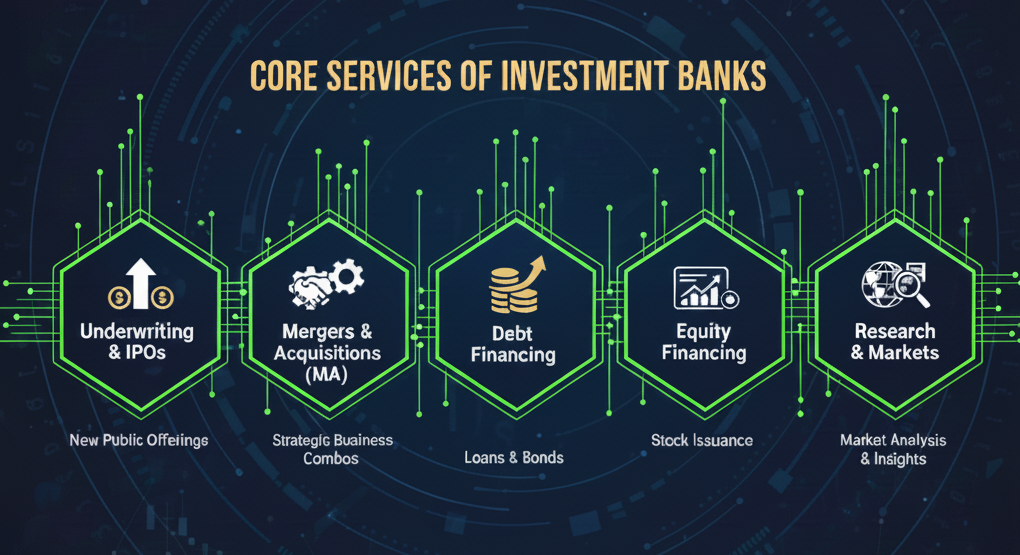
Underwriting & IPOs
Investment banks help companies go public by structuring stock offerings, preparing prospectuses, pricing shares, and selling them to investors. They manage risk by underwriting the issue and ensuring sufficient demand.
Mergers & Acquisitions (M&A)
They advise companies on buying, selling, or merging businesses. This includes valuing firms, negotiating deal terms, conducting due diligence, and arranging financing.Debt Financing
Investment banks structure bond issuances or large loans for corporations and governments, allowing borrowers to raise capital upfront and repay it over time with interest.Equity Financing
They connect companies with institutional investors who inject capital in exchange for ownership, helping businesses grow without taking on debt.Research & Markets
Large investment banks operate research teams and trading desks that help clients buy and sell securities while providing market insights and liquidity.
Much of this work happens quietly on trading floors, in boardrooms, and through complex financial models. Investment banks earn fees by structuring and executing these transactions, acting as intermediaries between capital and opportunity.
How Investment Banks Differ from Retail and Commercial Banks
Although they share the word “bank,” retail, commercial, and investment banks play very different roles in the financial system.
Retail banks serve individuals, offering savings accounts, credit cards, mortgages, and personal loans. They are funded primarily by customer deposits.
Commercial banks serve businesses, providing loans, credit facilities, and cash management services. They also rely on deposits.
Investment banks serve corporations, governments, and institutions. They focus on IPOs, bond issuance, M&A advisory, trading, and asset management, and do not accept public deposits.
For large transactions, investment banks often form underwriting syndicates. For example, when Ant Group filed for its IPO, banks including Goldman Sachs, JPMorgan, and Morgan Stanley worked together to manage the offering.
Core Roles in Capital Markets
Investment banks perform several functions that are critical to how capital markets operate.
Equity Capital Markets (IPOs & Stock Offerings)
Investment banks bring companies to market by underwriting new shares, setting initial prices, and distributing stock to investors. This process requires balancing the company’s capital needs with investor expectations. Alibaba’s IPO is a prime example of how multiple global banks collaborated to successfully raise billions.
Mergers & Acquisitions Advisory
In M&A transactions, investment banks guide companies through complex negotiations and financing decisions. Leading firms such as JPMorgan, Goldman Sachs, and Morgan Stanley advise on hundreds of billions of dollars in deals annually. In Q1 2023 alone, JPMorgan ranked as the world’s top M&A advisor, with nearly $120 billion in deals advised.
Debt Capital Markets (Bond Issuance)
Investment banks help companies and governments raise funds through bonds. They structure the offering, determine interest rates, and distribute bonds to investors. For instance, AT&T’s $5 billion bond issuance was led by major global banks, demonstrating the scale and importance of this function.
Beyond these roles, many investment banks also operate asset management and trading divisions that complement their advisory services.
Why Investment Banks Matter for Traders and Analysts
For traders, analysts, and finance professionals, understanding investment banks is essential.
Investment banks:
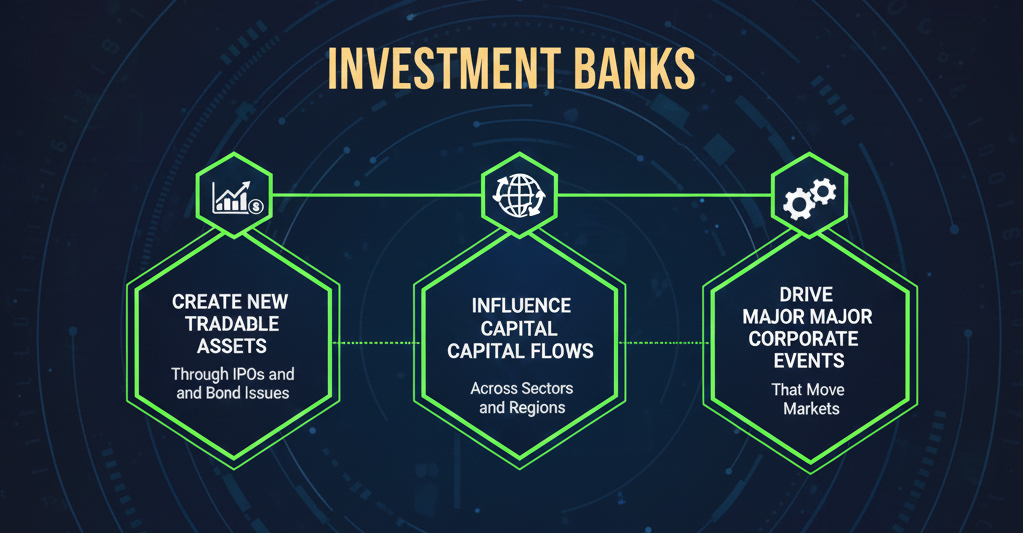
Create new tradable assets through IPOs and bond issues
Influence capital flows across sectors and regions
Drive major corporate events that move markets
When a large merger is announced or a major IPO launches, stock prices, sector valuations, and market sentiment often shift sharply. Knowing how and why these deals are structured gives traders a deeper understanding of market behaviour and potential opportunities.
Building Market Understanding the Right Way
Most large financial events-IPOs, mergers, debt issuances-happen under the guidance of investment banks. That’s why aspiring traders and analysts benefit from learning how these institutions operate.
At Derivion, this institutional understanding is a core part of the curriculum. The UK-accredited executive program combines strong market foundations with live-market exposure, guided by professionals with experience at institutions such as J.P. Morgan and Nasdaq. Students learn not just how to trade, but how capital markets function at a structural level.
Final Thought
Investment banks are the engines behind modern finance. They channel global capital into businesses and governments, enabling growth, innovation, and economic development. While their work often stays out of the spotlight, its impact is felt across every financial market.
For anyone pursuing a career in finance, trading, or investment analysis, understanding the role of investment banks is not optional-it’s essential. By learning how these institutions structure deals and influence markets, you gain insight into the forces that shape global finance every day.
Want to understand markets the way institutions do?
Explore Derivion’s executive training programme and learn how professional institutions think, trade, and operate in real markets.
Derivion’s UK-accredited executive programme bridges theory and real-world practice, guided by former professionals from J.P. Morgan and Nasdaq. Learn how capital markets actually function—and how to apply that insight in live trading environments.